
-
 Wagner, HansKurtze doch gegründte beschreibung des... Hochzeitlichen Ehren Fests... in der Fürstlichen Haubtstat München, 1568. Munich. Adam Berg.The 1568 Munich Ducal Wedding Fête Book, a fine copy in exceptional contemporary color
First edition and a superb copy fully coloured by a contemporary hand, of this remarkable Bavarian Fête book, considered to be one of the rarest, most significant and most lavish produced in 16th century Europe, the copy of the Court Library at Donaueschingen. It is illustrated with delicate copperplate engravings of festival scenes at the Court of Wilhelm V, Duke of Bavaria, (1548-1626) staged for his marriage to Renée, Duchess of Lorraine (1544-1602). -
Botero, GiovanniLe relationi universali [...], divise in sette parti. Quinta impressione stampate & ricorrette. (With:) Aggiunta alla quarta parte dell'Indie [...], 1622-1623. Venice. Alessandro Vecchi.A work at the forefront of Renaissance ethnography, with woodcuts by Burgkmair
A pioneering work of Renaissance ethnography, in its rarer revised and augmented form, including the "Aggiunta" and additional woodcuts by the great German printmaker Hans Burgkmair that depict fantastical and legendary creatures believed to inhabit the far reaches of the world, as well as indigenous peoples of foreign lands in Africa, Arabia, etc. Arabia is pictured on both the Asia and the Africa map. An excellent copy of a pioneering work at the forefront of Renaissance ethnography and woodcut art. -
Chen Menglei (ed.)Gujin tushu jicheng [Complete collection of pictures and books of old and modern time]. Vols. 73-74; 85-86; 191-192 (Jingji huibian - Economy), 1726-1728. Beijing. Wuying dian, Nei-fu.Palace brass movable-type volumes from the largest encyclopedia in pre-modern China
The palace-printed first edition of the great Imperial Encyclopedia of China. Compiled on the order of the Kangxi Emperor and initially edited by Chen Menglei between 1701 and 1706, the work was revised over the next two decades and brought to press under the Yongzheng Emperor, with printing undertaken inside the Forbidden City at the Wuying dian.
-
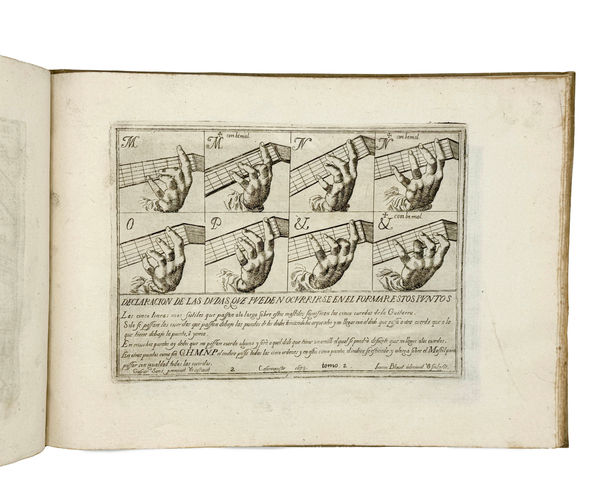
Sanz, Gaspar FranciscoInstruccion de musica sobre la Guitarra Española, y metodo de sus primeros rudimentos hasta tañerla con destreza, 1697. Zaragoza. Herederos de Diego Dormer.The most important work about Spanish guitar of the 17th century and one of the best records we have in baroque guitar
First complete edition, of the “most comprehensive guitar treatise of its time” (TNG, xvi, 486), and the second book on guitar published in Spain, following a short treatise by Amat; to-date, an important record of what we know of classical guitar repertory and techniques. The first and second parts were published independently on 1674 and 1675; this is the first appearance of the third part and as a complete work. -
Gheyn, Jacob II de[The riding school or exercise of cavalry], [Leiden, workshop of Jacob II de Gheyn, 1599].Rare first edition of a magnificent series of armed riders in action, commissioned by Prince Maurice of Orange
Very rare first edition of this magnificent series of cavalrymen and lansquentes in various positions, bound for Henry Frederick, Prince of Wales (1598-1612) with his coat-of-arms on the boards. -
Bernard von BreydenbachPeregrinatio in Terram Sanctam. 11. II, 1486. Mainz, Erhard Reuwich (with types of Peter Schöffer).Jean-Baptiste Colbert's Breydenbach: the first printed travel report of the Middle East, including the first Arabic alphabet in print
Editio princeps of the first modern account of a journey from Venice to the Holy Land: Jean-Baptiste Colbert's copy, preserved in its elegant, 17th century marbled vellum binding, and later in the library of the Earls of Macclesfield.
-
San Antonio, Juan Francisco deChronicas de la apostolica Provincia de S. Gregorio de religiosos descalzos de N.S.P.S. Francisco en las Islas Philipinas, China, Japon, &c, 1738-44. Sampaloc. Fr. Juan del Sotillo.One of the most important works ever published in Manila
First edition. A true testimony to the excellence of the Manila printing industry, titles in red and black, woodcut floral borders, text in double columns, engraved vignettes, and the famous plate of the 23 Gloriosos Martyrios, printed in Manila. The plate shows the martyrdom of San Pedro Bautista along with his 22 other companions in Japan (1597). -
Hulsen, Esaias vanAigentliche wahrhaffte Delineatio[n] unnd Abbildung aller Fürstlichen Auffzüg und Rütterspilen. Bey deß [...] Herren Johann Friderichen Hertzogen zu Württemberg [...] Sohns Hertzog Ulrichen [...] Kindtauff: und dann bey [...] Herren Ludwigen Friderichen H, 1618. Stuttgart. Esaias von Hulsen.Graphically outstanding Württemberg Festbuch: author's copy
Graphically outstanding and highly rare Festbuch, a superb example of early Baroque festival books: the monumental pictorial record of the Württemberg court celebrations for the baptism of Prince Ulrich, son of Duke John Frederick of Württemberg (1582-1628), and the wedding festivities for his brother Louis Frederick with Magdalena Elizabeth of Hesse. The double occasion, celebrated in Stuttgart over five days in July 1617, was elaborately staged with a ceremonial pageant, tournament, and splendid allegorical display. Guests of honour include Princess Elizabeth of England and her husband Friedrich, Elector of the Palatine. This was the last Württemberg court festival before the outbreak of the Thirty Years' War. -
[Greenlandic folk-tales]Kaladlit Okalluktualliait [Grönlandske Folkesagn], Noungme [Nuuk], Lars Møller, i Inspectoratets Bogtrykkeri, 1859-1863.The first collection of Greenlandic folk-tales, as told and illustrated by native Inuit
A landmark collection of Greenlandic folk-tales, told and illustrated by native Greenlanders, printed on the first major printing-press in the country. The stories drew on centuries of oral tradition, and included topics such as conflict between the Greenlanders and the Norse colonists who settled the country during the Viking Age. These four volumes are illustrated with numerous woodcuts, most of them by the native hunter and artist Aron of Kangeq, executed in a distinctive and evocative style. -
Toyokuni, Utagawa (ill.) / Ichibito, AsakusaYakusha awase kagami [A mirror of actors' physiognomies], Edo [Toto], Bunshundo and Yamadaya Sanshiro, Kyowa 4 (1804).One of the outstanding woodcut books devoted to Kabuki actors
An outstanding and extremely rare actor book: Asakusa Ichibito's "Yakusha awase kagami", illustrated by Utagawa Toyokuni, is one of the finest surviving colour-printed kabuki books of the early nineteenth century. This complete copy is particularly remarkable for its freshness of impression and colour.
-
Turrecremata, Johannes deMeditationes seu Contemplationes devotissimae, 21 August 1498. Rome. Stephan Plannck.One of the finest illustrated books of the 15th century, first use of this set of woodcuts
First edition in reduced format, a synthesis of the archaic style of the printer Ulrich Han and the Napolitan Francesco del Tuppo in a new series of wood engravings by Stephan Planck.

![Botero, Giovanni, Le relationi universali [...], divise in sette parti. Quinta impressione stampate & ricorrette. (With:) Aggiunta alla quarta parte dell'Indie [...], 1622-1623. Venice. Alessandro Vecchi.](https://static-assets.artlogic.net/w_600,c_limit,f_auto,fl_lossy,q_auto/artlogicstorage/hsrarebooks/images/view/b44d688b548d8ff0b19b968476c86bd1j/hsrarebooks-botero-giovanni-le-relationi-universali-...-divise-in-sette-parti.-quinta-impressione-stampate-ricorrette.-with-aggiunta-alla-quarta-parte-dell-indie-...-1622-1623.-ven.jpg)
![Chen Menglei (ed.), Gujin tushu jicheng [Complete collection of pictures and books of old and modern time]. Vols. 73-74; 85-86; 191-192 (Jingji huibian - Economy), 1726-1728. Beijing. Wuying dian, Nei-fu.](https://static-assets.artlogic.net/w_600,c_limit,f_auto,fl_lossy,q_auto/artlogicstorage/hsrarebooks/images/view/972237b8e0d418799bfd12bcb5452aacj/hsrarebooks-chen-menglei-ed.-gujin-tushu-jicheng-complete-collection-of-pictures-and-books-of-old-and-modern-time-.-vols.-73-74-85-86-191-192-jingji-huibian-economy-1726-1728.-beij.jpg)
![Gheyn, Jacob II de, [The riding school or exercise of cavalry], [Leiden, workshop of Jacob II de Gheyn, 1599].](https://static-assets.artlogic.net/w_600,c_limit,f_auto,fl_lossy,q_auto/artlogicstorage/hsrarebooks/images/view/2eff8b7829e23335c9c651745034ccd7j/hsrarebooks-gheyn-jacob-ii-de-the-riding-school-or-exercise-of-cavalry-leiden-workshop-of-jacob-ii-de-gheyn-1599-..jpg)


![Hulsen, Esaias van, Aigentliche wahrhaffte Delineatio[n] unnd Abbildung aller Fürstlichen Auffzüg und Rütterspilen. Bey deß [...] Herren Johann Friderichen Hertzogen zu Württemberg [...] Sohns Hertzog Ulrichen [...] Kindtauff: und dann bey [...] Herren Ludwigen Friderichen H, 1618. Stuttgart. Esaias von Hulsen.](https://static-assets.artlogic.net/w_600,c_limit,f_auto,fl_lossy,q_auto/artlogicstorage/hsrarebooks/images/view/2ede28fa17f2475a32bc017b45fc2742j/hsrarebooks-hulsen-esaias-van-aigentliche-wahrhaffte-delineatio-n-unnd-abbildung-aller-f-rstlichen-auffz-g-und-r-tterspilen.-bey-de-...-herren-johann-friderichen-hertzogen-zu-w-rtt.jpg)
![[Greenlandic folk-tales], Kaladlit Okalluktualliait [Grönlandske Folkesagn], Noungme [Nuuk], Lars Møller, i Inspectoratets Bogtrykkeri, 1859-1863.](https://static-assets.artlogic.net/w_600,c_limit,f_auto,fl_lossy,q_auto/artlogicstorage/hsrarebooks/images/view/d4acd612fa889660b420bf73c559697bj/hsrarebooks-greenlandic-folk-tales-kaladlit-okalluktualliait-gr-nlandske-folkesagn-noungme-nuuk-lars-m-ller-i-inspectoratets-bogtrykkeri-1859-1863..jpg)
![Toyokuni, Utagawa (ill.) / Ichibito, Asakusa, Yakusha awase kagami [A mirror of actors' physiognomies], Edo [Toto], Bunshundo and Yamadaya Sanshiro, Kyowa 4 (1804).](https://static-assets.artlogic.net/w_600,c_limit,f_auto,fl_lossy,q_auto/artlogicstorage/hsrarebooks/images/view/e28f752c0a692f417d8d5c73b1455005j/hsrarebooks-toyokuni-utagawa-ill.-ichibito-asakusa-yakusha-awase-kagami-a-mirror-of-actors-physiognomies-edo-toto-bunshundo-and-yamadaya-sanshiro-kyowa-4-1804-..jpg)

Join our mailing list
* denotes required fields
We will process the personal data you have supplied to communicate with you in accordance with our Privacy Policy. You can unsubscribe or change your preferences at any time by clicking the link in our emails.