
![[Burmese manuscript - Buddhism], Sutta Vibhanga in manuscript chest, S.a. [ca. 1850 CE]. S.l. [Burma]](https://artlogic-res.cloudinary.com/w_1600,h_1600,c_limit,f_auto,fl_lossy,q_auto/artlogicstorage/hsrarebooks/images/view/72fd2f589d4a9f6a454f4fd3d42d9789j/hsrarebooks-burmese-manuscript-buddhism-sutta-vibhanga-in-manuscript-chest-s.a.-ca.-1850-ce-.-s.l.-burma.jpg)
![[Burmese manuscript - Buddhism], Sutta Vibhanga in manuscript chest, S.a. [ca. 1850 CE]. S.l. [Burma]](https://artlogic-res.cloudinary.com/w_1600,h_1600,c_limit,f_auto,fl_lossy,q_auto/artlogicstorage/hsrarebooks/images/view/a708f531b4aaccc5fd6c72422d957a9bj/hsrarebooks-burmese-manuscript-buddhism-sutta-vibhanga-in-manuscript-chest-s.a.-ca.-1850-ce-.-s.l.-burma.jpg)
![[Burmese manuscript - Buddhism], Sutta Vibhanga in manuscript chest, S.a. [ca. 1850 CE]. S.l. [Burma]](https://artlogic-res.cloudinary.com/w_1600,h_1600,c_limit,f_auto,fl_lossy,q_auto/artlogicstorage/hsrarebooks/images/view/d6f5af15d16e5c56eb89d8503b26091dj/hsrarebooks-burmese-manuscript-buddhism-sutta-vibhanga-in-manuscript-chest-s.a.-ca.-1850-ce-.-s.l.-burma.jpg)
![[Burmese manuscript - Buddhism], Sutta Vibhanga in manuscript chest, S.a. [ca. 1850 CE]. S.l. [Burma]](https://artlogic-res.cloudinary.com/w_1600,h_1600,c_limit,f_auto,fl_lossy,q_auto/artlogicstorage/hsrarebooks/images/view/389d8b22fc6f6f59d6850957eb6c3ca7j/hsrarebooks-burmese-manuscript-buddhism-sutta-vibhanga-in-manuscript-chest-s.a.-ca.-1850-ce-.-s.l.-burma.jpg)
![[Burmese manuscript - Buddhism], Sutta Vibhanga in manuscript chest, S.a. [ca. 1850 CE]. S.l. [Burma]](https://artlogic-res.cloudinary.com/w_1600,h_1600,c_limit,f_auto,fl_lossy,q_auto/artlogicstorage/hsrarebooks/images/view/eb43e935b6735eb4520cc6db81fcddc1j/hsrarebooks-burmese-manuscript-buddhism-sutta-vibhanga-in-manuscript-chest-s.a.-ca.-1850-ce-.-s.l.-burma.jpg)
![[Burmese manuscript - Buddhism], Sutta Vibhanga in manuscript chest, S.a. [ca. 1850 CE]. S.l. [Burma]](https://artlogic-res.cloudinary.com/w_1600,h_1600,c_limit,f_auto,fl_lossy,q_auto/artlogicstorage/hsrarebooks/images/view/bcf8c756406427c9c524133a2dc523d7j/hsrarebooks-burmese-manuscript-buddhism-sutta-vibhanga-in-manuscript-chest-s.a.-ca.-1850-ce-.-s.l.-burma.jpg)
![[Burmese manuscript - Buddhism], Sutta Vibhanga in manuscript chest, S.a. [ca. 1850 CE]. S.l. [Burma]](https://artlogic-res.cloudinary.com/w_1600,h_1600,c_limit,f_auto,fl_lossy,q_auto/artlogicstorage/hsrarebooks/images/view/7d24a204c4632bc09d53025a1f405abej/hsrarebooks-burmese-manuscript-buddhism-sutta-vibhanga-in-manuscript-chest-s.a.-ca.-1850-ce-.-s.l.-burma.jpg)
![[Burmese manuscript - Buddhism], Sutta Vibhanga in manuscript chest, S.a. [ca. 1850 CE]. S.l. [Burma]](https://artlogic-res.cloudinary.com/w_1600,h_1600,c_limit,f_auto,fl_lossy,q_auto/artlogicstorage/hsrarebooks/images/view/d60b4c8f8fc53b10f798d3fb9b6b4e31j/hsrarebooks-burmese-manuscript-buddhism-sutta-vibhanga-in-manuscript-chest-s.a.-ca.-1850-ce-.-s.l.-burma.jpg)
![[Burmese manuscript - Buddhism], Sutta Vibhanga in manuscript chest, S.a. [ca. 1850 CE]. S.l. [Burma]](https://artlogic-res.cloudinary.com/w_1600,h_1600,c_limit,f_auto,fl_lossy,q_auto/artlogicstorage/hsrarebooks/images/view/0bc97909d1726b4f093b54f4ecb8b24dj/hsrarebooks-burmese-manuscript-buddhism-sutta-vibhanga-in-manuscript-chest-s.a.-ca.-1850-ce-.-s.l.-burma.jpg)
![[Burmese manuscript - Buddhism], Sutta Vibhanga in manuscript chest, S.a. [ca. 1850 CE]. S.l. [Burma]](https://artlogic-res.cloudinary.com/w_1600,h_1600,c_limit,f_auto,fl_lossy,q_auto/artlogicstorage/hsrarebooks/images/view/b65bf580c7c1d9db6eee809b07c9d2e2j/hsrarebooks-burmese-manuscript-buddhism-sutta-vibhanga-in-manuscript-chest-s.a.-ca.-1850-ce-.-s.l.-burma.jpg)
[Burmese manuscript - Buddhism]
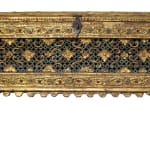
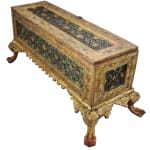
Housed in a rare surviving manuscript case: a Burmese lacquered manuscript of a Buddhist monastic text. The manuscript case, called a sedaik, is rarely preserved alongside such manuscripts. Such cases were specially made for manuscripts held in monasteries and in the homes of wealthy Buddhist families; lavishly decorated and painted in gold, with five sides made up of a metal grille punched with geometric designs, the sedaik signifies the importance of the text housed inside. It had practical uses as well: raised off the floor on four legs, it kept manuscripts away from water damage, and its decorative metal grille was a useful defence against rats and mice.
Further images
-
(View a larger image of thumbnail 1
)
-
(View a larger image of thumbnail 2
)

-
(View a larger image of thumbnail 3
)

-
(View a larger image of thumbnail 4
)

-
(View a larger image of thumbnail 5
)
-
(View a larger image of thumbnail 6
)
-
(View a larger image of thumbnail 7
)

-
(View a larger image of thumbnail 8
)
-
(View a larger image of thumbnail 9
)

-
(View a larger image of thumbnail 10
)
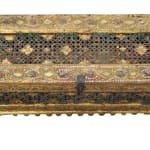


The manuscript housed in this sedaik is a section of the Sutta Vibhanga which describes a parajika: one of the four forbidden failures of monastic life which, if perpetrated, would see a monk banned from re-entering a monastery for the rest of his current reincarnation. These parajika include sexual intercourse, theft, murder or inciting a death, and lying about one's spiritual level along the path to Enlightenment. The Sutta Vibhanga is an important text of Theravada Buddhism, and dictates many such aspects of Buddhist monastic life.
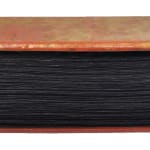
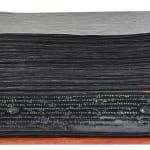
The text of this manuscript is written in creamy yellow Burmese square script on a field of black lacquer, bordered in red and decorated with gilt. This black lacquer field and pale script are an uncommon combination; similar manuscripts are more commonly seen in black ink on fields of red-and-gold. Fine lacquer manuscripts such as this one were commissioned by wealthy laypeople and donated to a local monastery, an action through which the donors would gain spiritual merit, as well as enriching their local monastic libraries.
Provenance: from the collection of a private estate in Edinburgh, Scotland, acquired during the colonial era.
Join our mailing list
* denotes required fields
We will process the personal data you have supplied in accordance with our privacy policy (available on request). You can unsubscribe or change your preferences at any time by clicking the link in our emails.